A Foundation of Collaboration
Roundtables Set the Stage for 2025 Legislative Priorities
Heading into the 2025 Legislative Session, Coalition for a Healthy Oregon (COHO) is targeting several priorities to sustain and improve Oregon’s coordinated care model. Much like how CCOs serve members in their communities by working with local organizations, it takes strong partnerships and collaboration to pass statewide reforms, which is why we brought together key decision-makers for a series of roundtable discussions in 2024.
The first of these roundtables came in April. Guests included state lawmakers and former Gov. John Kitzhaber, who oversaw the formation of the coordinated care model in 2012. Kitzhaber called for a reassessment of its vision to ensure CCOs can meet evolving health care needs and goals.

Former Gov. John Kitzhaber speaks at a roundtable hosted by COHO in April 2024.
As discussions continued, our CCO leaders expressed their need for greater spending flexibility and contract stability to better serve members.
The next two roundtables in August and December dove more deeply into early childhood/maternal care and behavioral health, respectively. Senator Lisa Reynolds (D-Beaverton) outlined her 2025 “Momnibus” bill to expand care for moms and infants.
“If we can help families meet their basic needs, then a lot of good flows from that,” said Reynolds, a pediatrician for more than 30 years. “And if we don’t, almost nothing else matters, right?”
On behavioral health, Dr. Emma Sandoe, Medicaid Director for the Oregon Health Authority, stressed the need to improve access to services and increase provider availability. Accomplishing this is no easy feat given geographic barriers, workforce shortages, and other challenges. However, CCOs are uniquely positioned to find solutions through community partnerships and targeted investments in upstream prevention.
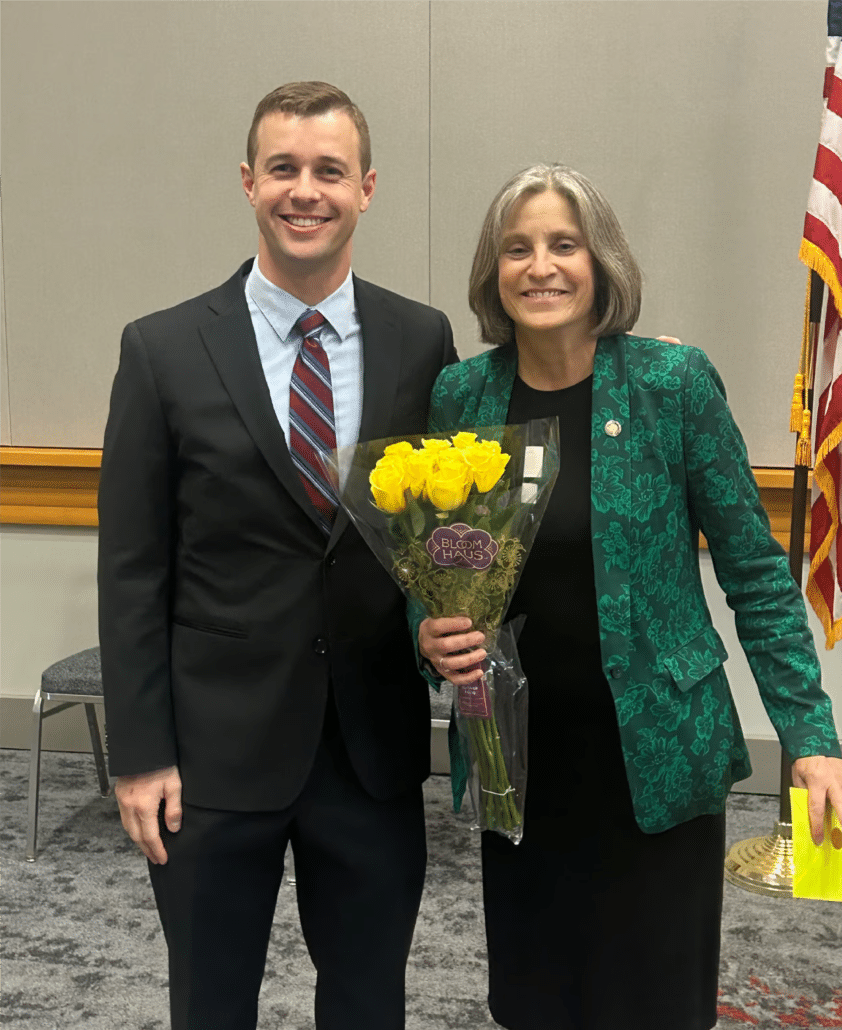
Dan Cushing, left, government affairs director for Yamhill Community Care, and Senator Lisa Reynolds at Reynolds’ swearing-in ceremony in December.
Each roundtable was instrumental in helping COHO identify legislative priorities for 2025 that will strengthen CCOs and lead to a healthier Oregon.
The Prioritized List is foundational to the Oregon Health Plan, ensuring that health care dollars are spent on the most critical, effective services. Eliminating it would risk higher costs while reducing efficiency and equity of care.
COHO is backing legislation in 2025 that will protect the Prioritized List. This will:
- Preserve Oregon’s ability to deliver efficient, equitable, and sustainable care.
- Ensure that health care funding continues to prioritize evidence-based services that improve health outcomes.
- Support local CCOs in delivering cost-effective, community-driven care.
The current 5-year CCO contracts create instability in Oregon’s Medicaid system, hindering long-term planning and investment. They lead to administrative churn that deters multi-year investments necessary to innovate, improve health outcomes, and reduce costs.
Having 10-year contracts with a five-year check-in reduces administrative burden for the state and CCOs, and provides stability needed to invest in long-term programs that address key community health priorities, including behavioral health and housing.
“The last thing our communities need from us is uncertainty,” says Seamus McCarthy, president and CEO of Yamhill Community Care. “Our local communities deserve to know we have their backs.”
The next round of CCO procurement should include the following standards:
- Performance-based evaluation.
- Safeguarding continuity of care.
- Community relationships and investments.
- Stakeholder feedback.
- Transparency and accessibility.
These standards will help ensure equitable, transparent, and community-centered processes that better align with Oregon’s health care goals.

“Our roundtable discussions in 2024 have us well positioned to make strides in 2025. Strong collaboration is at the heart of the coordinated care model, and we are looking forward to a productive session in the months to come.”
— Seamus McCarthy, President and CEO, Yamhill Community Care

