
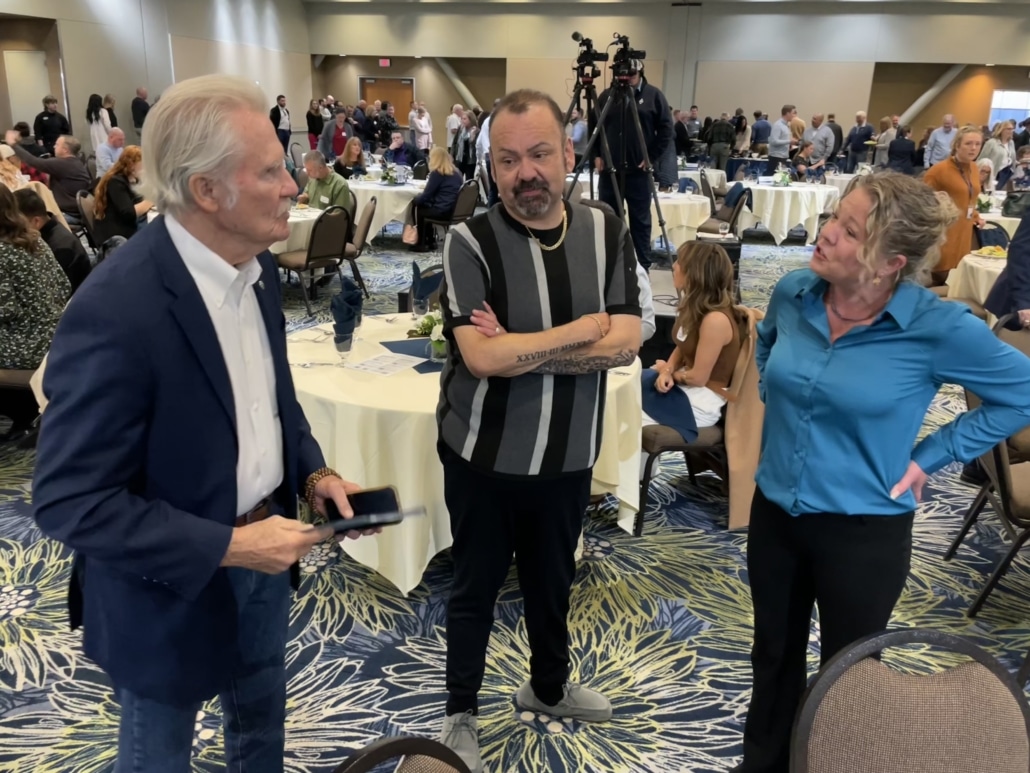
Former Oregon Gov. Kitzhaber Calls for Shared Vision on Health Care
While discussing the future of health care policy, former Oregon Gov. John Kitzhaber hearkened back to President John F. Kennedy’s 1962 speech at Rice University where he boldly declared the U.S. would land a man on the moon by the end of the decade.
The challenges Kennedy described were daunting — sending a rocket made of untested metal alloys 240,000 miles to the moon and 240,000 miles back, where it would reenter the Earth’s atmosphere at speeds exceeding 25,000 miles per hour, heating up to about half the temperature of the sun. In other words, an “untried mission to an unknown celestial body.”
“What an amazing leap of imagination that was,” said Kitzhaber, who spoke with business leaders and local elected officials at the Salem Area Chamber of Commerce’s Forum Speaker Series on Oct. 20. “Kennedy didn’t give us a roadmap. He gave us a destination. And in doing so, he changed the nature of the debate from where we want to go to how we get there, inspiring the innovation and passion of our nation in a common cause.”
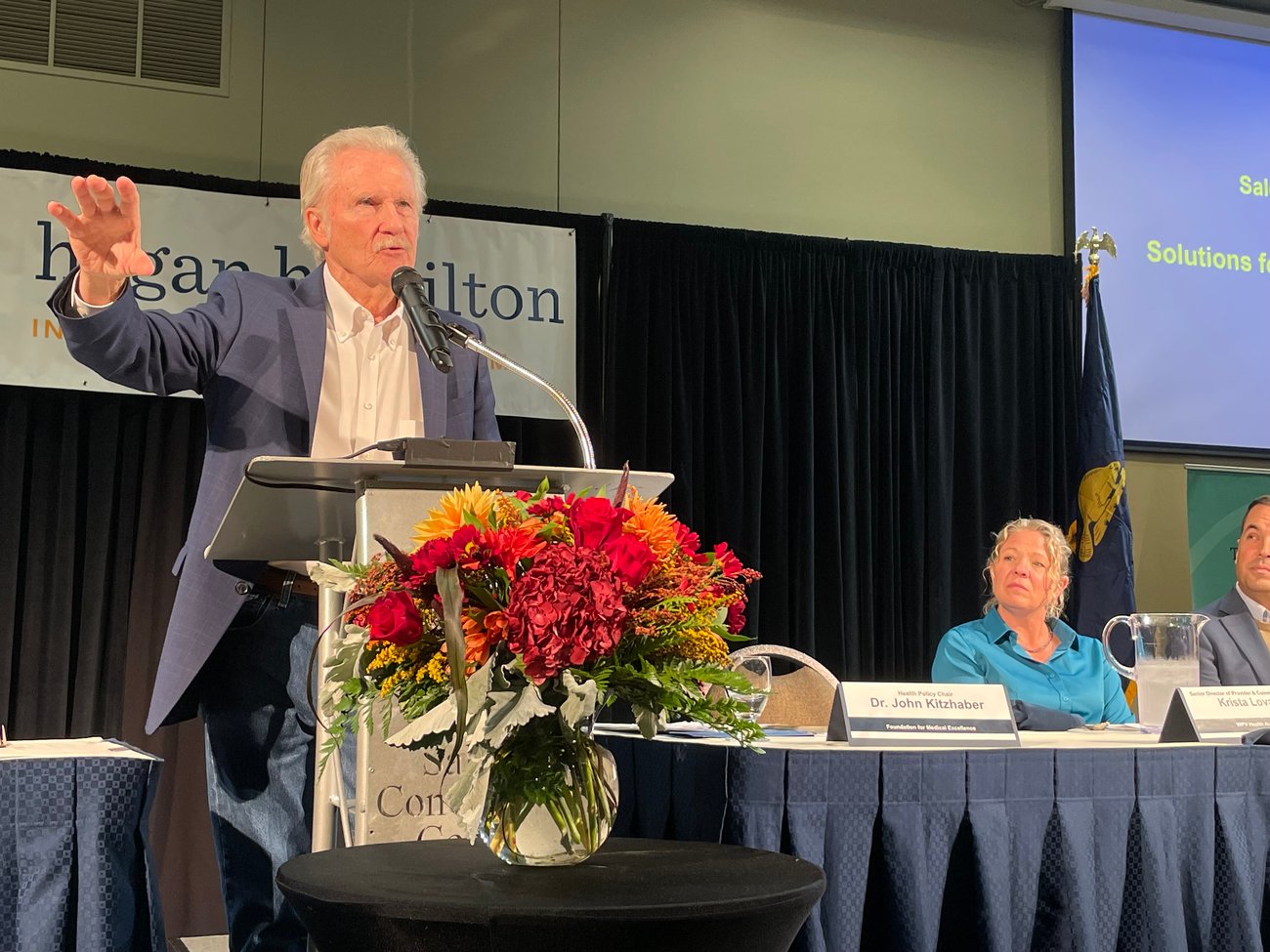
Former Gov. John Kitzhaber speaks at a forum hosted by the Salem Area Chamber of Commerce on Oct. 20.
Kitzhaber, who now serves as Health Policy Chair at the Portland-based Foundation for Medical Excellence, delivered a similar call to action for addressing problems in health care, including rising costs and gaps in coverage. Finding solutions, he said, will require systematic changes. That all begins with a shared vision.
“The fact is, we’re all in the same canoe here,” Kitzhaber said. “We all need health care.”
A Partisan Football
The forum was sponsored by WVP Health Authority, an association of more than 450 independent health providers across 93 practices in the Willamette Valley.
Krista Lovaas, Senior Community and Provider Relations Director for the association, said that, thanks to Kitzhaber’s leadership, independent physicians across Oregon have been able to continue practicing medicine in the communities they love.
“His deep understanding of what happens in an exam room, paired with his policy expertise, has allowed Oregon to build one of the most effective, compassionate Medicaid systems in the country,” Lovaas said.
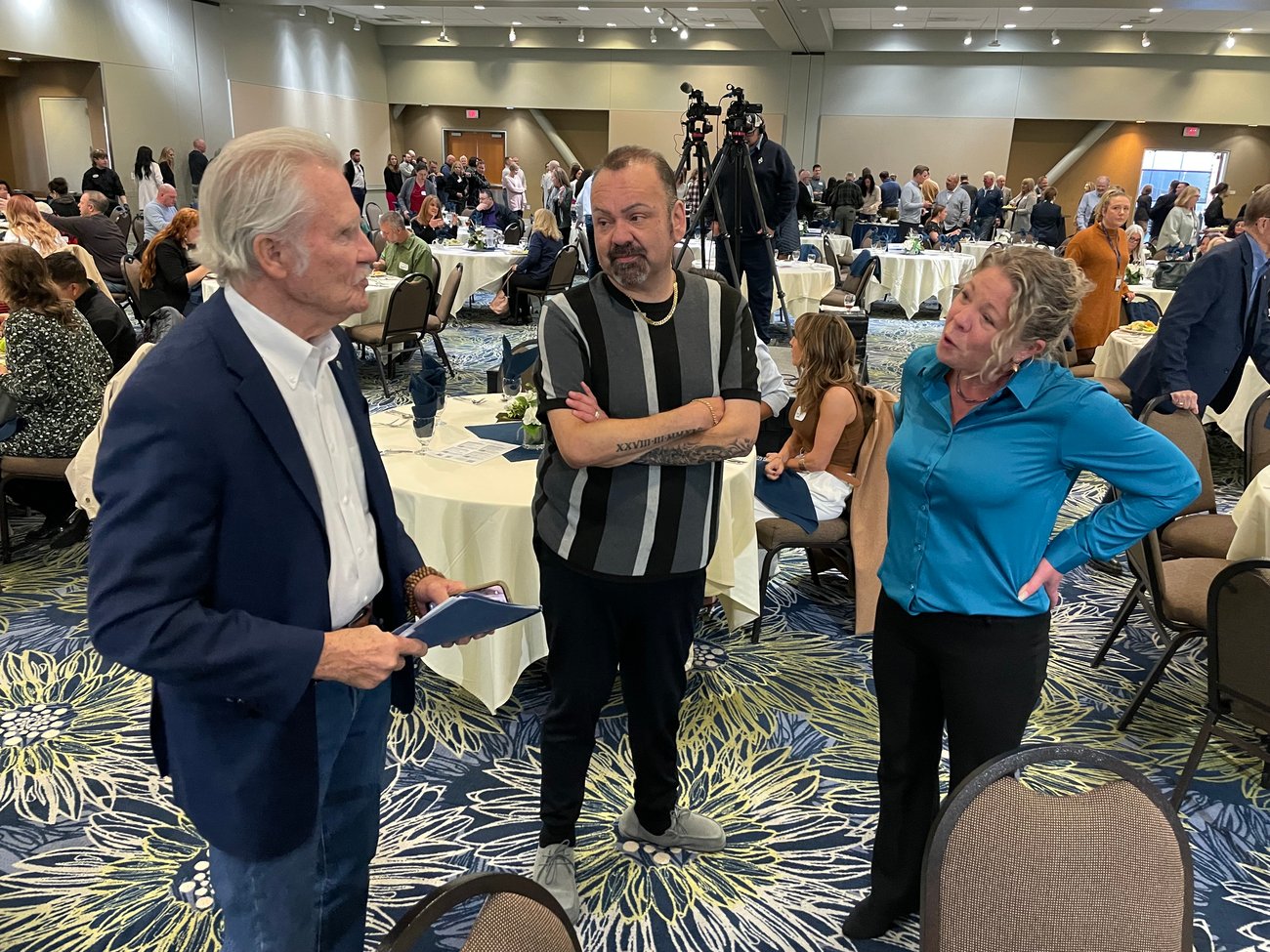
John Kitzhaber speaks with Manuel Rivera (center) and Krista Lovaas (right) of WVP Health Authority.
Kitzhaber, who now serves as Health Policy Chair at the Portland-based Foundation for Medical Excellence, delivered a similar call to action for addressing problems in health care, including rising costs and gaps in coverage. Finding solutions, he said, will require systematic changes. That all begins with a shared vision.
As a state senator and later governor, Kitzhaber was a chief architect of the Oregon Health Plan and the creation of Oregon’s coordinated care model in 2012, which has helped 97% of Oregonians to have health insurance as of 2023.
However, Kitzhaber noted that while the passage of the Affordable Care Act sought to make health care more affordable, it did so not by actually lowering costs but by shifting more of those costs to the federal government. Now, those subsidies have been eliminated in the federal tax and spending bill passed by congressional Republicans earlier this year and are a central point of contention in the ongoing government shutdown.
Oregon stands to lose about $11.5 billion federal Medicaid funding over the next decade, triggering a multi-biennial budget crisis not seen since the Great Recession, Kitzhaber said. But like the ACA before it, he said the legislation fails to address the underlying problem with health care, which he described as an “overly complex and inefficient system” that has made health care unaffordable for individuals, government, and employers alike.
“The legislation will reduce the cost of health care to the federal government in the short term,” Kitzhaber explained, “but it’s simply going to shift those costs to employers through increases in their premiums in the commercial market.”
In short, Kitzhaber said Congress is engaged in a heated debate over the wrong problem, with both parties to blame. He said health care has “essentially become a partisan football,” while fundamental flaws in the system go unfixed.
“The spin artists on both sides are crafting narratives not to curb the inflation in medical care, but rather to figure out how they can blame each other for the government shutdown … What about the blame of failing to address a health care business model that has given this country the dubious distinction of having the most expensive health care system on the planet, producing some of the worst world population health outcomes?”
— John Kitzhaber
Coming Together
The good news, Kitzhaber said, is that nobody is powerless to rise above the partisan bickering. But it will take everyone coming out of their silos to work together on a shared vision for health care going forward.
“I don’t think we can expect a solution in the next few months to come popping out of Washington, D.C., but we don’t have to let the health care system here in Oregon get swept over the fiscal precipice that’s rapidly emerging,” he said.
Oregon has solved complex challenges before, Kitzhaber said. It happened when reforming the state’s workers’ compensation system in 1990. It happened again when the state navigated a $3.5 billion budget shortfall at the end of the Great Recession in 2011.
Like JFK in 1962, Kitzhaber said creating a shared vision can be the catalyst that moves American forward on health care, just as it set the table for the first moon landing.
“We did it because we imagined it. We did it because the story preceded the accomplishment,” Kitzhaber said. “That’s why a shared vision for a health care system is so incredibly important.”
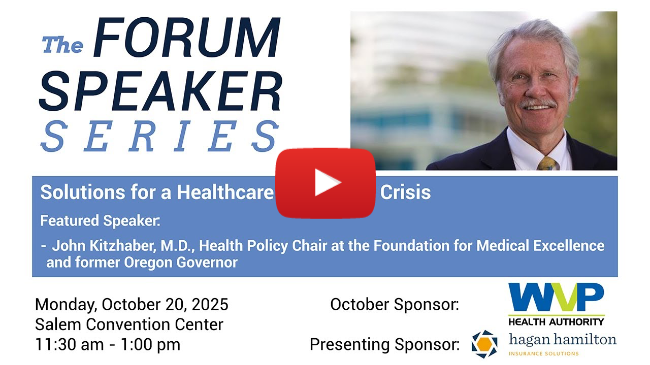
Watch the full forum by clicking on the video below.
 |

